
One of the most common questions we get at Tiny is some version of: “I need shirts — what’s the best way to put my logo on them?” It’s a great question, and the honest answer is: it depends.
Screen printing, direct to film transfers (DTF), and embroidery are all excellent options — but they’re not interchangeable. Each method has strengths that make it the right call for certain projects and the wrong call for others. Here’s a breakdown to help you figure out which one fits what you’re trying to do.
Screen Printing
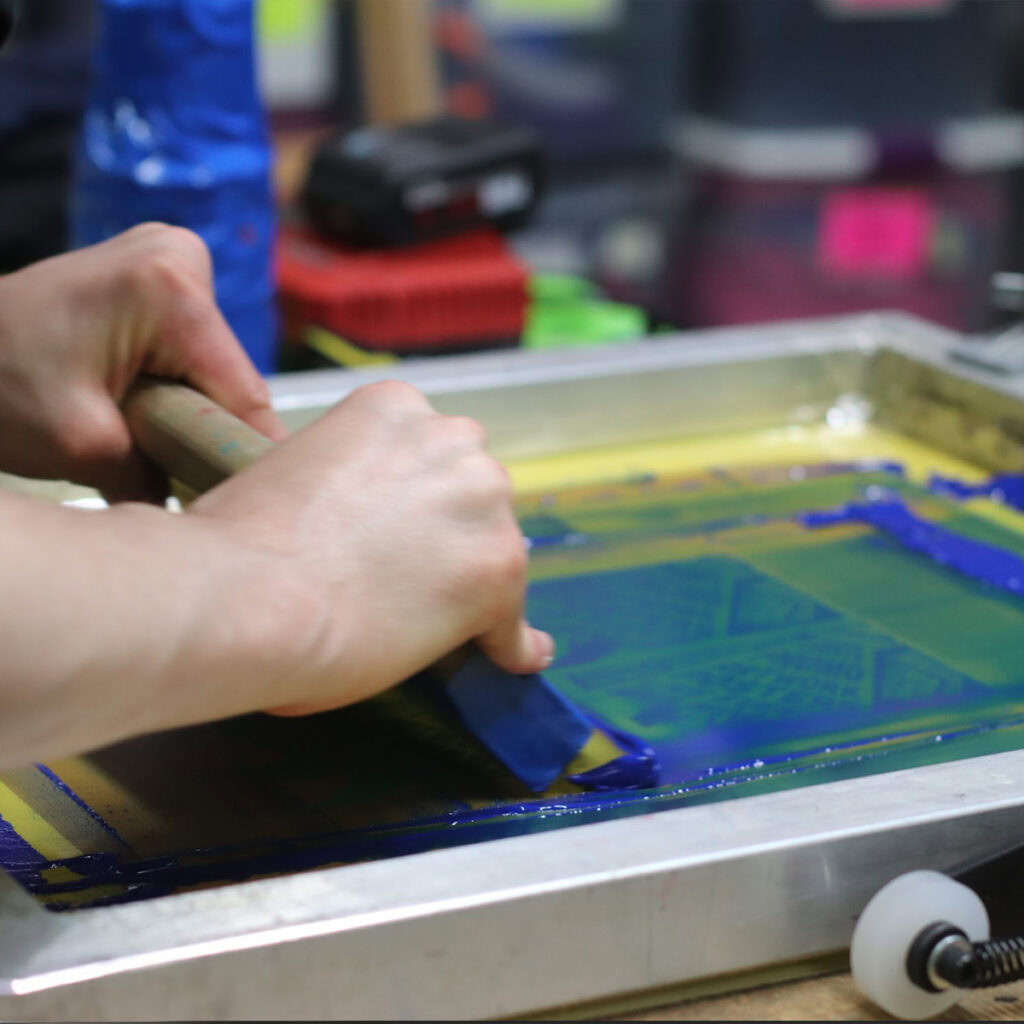
Screen printing is the classic. Ink is pressed through a mesh screen directly onto the fabric, one color at a time. It’s been the backbone of the apparel printing industry for decades, and for good reason.
It’s the right choice when:
- You’re ordering a larger quantity (generally 24 pieces or more)
- Your design has a limited number of solid colors
- You want vibrant, long-lasting color that holds up through heavy use and repeated washing
- You’re printing on t-shirts, hoodies, totes, or other flat garments
Screen printing produces some of the richest, most saturated color of any print method — and at volume, the per-piece cost is very competitive. It’s a go-to for event merch, staff uniforms, fundraiser tees, and anything where consistency matters.
The tradeoff: screen printing isn’t ideal for very small runs or designs with a lot of color gradients and fine photographic detail. Each color requires its own screen, so complexity adds up quickly.
Direct to Film (DTF) Transfers
DTF is a newer technology that’s changed what’s possible for shorter runs and more complex artwork. A design is printed onto a special film and then heat-transferred onto the garment. The result is a full-color print with soft edges and fine detail that screen printing can’t always achieve.
It’s the right choice when:
- You need a smaller quantity without sacrificing quality
- Your design has lots of colors, gradients, or photographic elements
- You want flexibility — DTF can go on almost any fabric type
- You’re mixing sizes or styles in the same order without needing a minimum per design
DTF is a great fit for one-off pieces, sample runs, or projects where the artwork is complex and the quantities are lower. It’s also ideal when you need a single design applied to a range of different garment styles.
The tradeoff: for very large runs of simple designs, screen printing will typically be more cost-effective and produce a slightly different feel underhand.
Embroidery
Embroidery is its own category entirely. Instead of ink, thread is stitched directly into the fabric using a computerized machine. The result is a dimensional, textured look that reads as polished and professional in a way that print methods simply don’t replicate.
It’s the right choice when:
- You’re decorating structured items like hats, polos, jackets, or bags
- Your logo or design is relatively clean and doesn’t rely on ultra-fine detail
- You want something that looks elevated — think company uniforms, branded workwear, corporate gifts
- Durability matters: embroidery doesn’t crack, fade, or peel
For businesses outfitting a team or anyone ordering apparel that needs to hold up to frequent wear and washing, embroidery is often the clear answer. It photographs well, it holds its shape, and it signals quality in a way that’s hard to miss.
The tradeoff: embroidery works best with bolder, simpler designs. Very intricate artwork with thin lines or small text can lose detail in the stitching process. And because setup involves digitizing the design for the embroidery machine, it’s generally better suited for repeat orders than one-time, one-piece requests.
So, Which One Is Right for You?
Here’s a simple way to think about it:
- Big run, bold design, flat garment? Screen printing.
- Smaller run, complex artwork, mixed styles? DTF.
- Hats, polos, outerwear, or anything that needs a polished, professional look? Embroidery.
Still not sure? That’s what we’re here for. At Tiny, we help customers figure out the right method for their project every day. Get in touch and we’ll help you think it through.